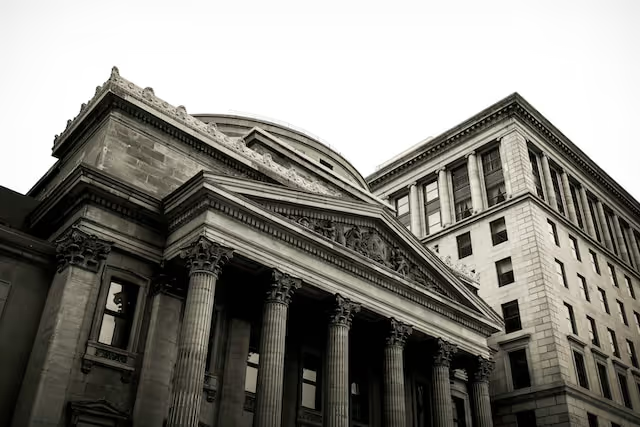
The Reserve Bank of New Zealand: What It Does, Why It Matters, and Its Track Record
You are reading an independently ranked global top-50 investing and finance blog. Become Wealth is independently owned, trusted to advise on over $1 billion, and one of only 49 New Zealand firms licensed to manage client portfolios directly.
The Reserve Bank of New Zealand (RBNZ) is the institution with the most direct influence over the cost of your mortgage, the return on your banked savings, and the purchasing power of every dollar in your pocket. It is New Zealand’s central bank. It sets the official cash rate (OCR), issues currency, supervises banks and insurers, and carries primary responsibility for keeping inflation low and stable.
If you are trying to understand why interest rates move, why groceries cost more than they used to, or why the housing market behaves the way it does, the RBNZ is the starting point.
This article explains what the RBNZ does, how its decisions reach your household, and how the institution has performed across its 90-year history. The record is mixed. New Zealand pioneered inflation targeting and was held up globally as a model of effective central banking for decades. It has also presided over bank bailouts, regulatory failures, a multi-billion-dollar money-printing experiment, and a governance crisis in 2025 that cost both its Governor and its Board Chair their positions.
RBNZ: Bank of the Banks
The RBNZ is not a bank you can open an account with. It sits above commercial banks like ANZ, BNZ, Westpac, ASB, and Kiwibank, setting the terms under which they borrow and lend.
Its primary job is maintaining price stability through the OCR, the interest rate at which commercial banks borrow from and deposit money with the Reserve Bank. When the OCR rises, borrowing across the economy becomes more expensive and spending slows. When it falls, money becomes cheaper, encouraging borrowing, spending, and investment. The OCR is reviewed eight times a year by the Monetary Policy Committee (MPC).
For a household with a floating or short-term fixed mortgage, changes to the OCR flow through to repayments within weeks. For savers, OCR movements influence the returns offered on term deposits and savings accounts, though banks set their own margins. The RBNZ is influential, but it does not operate in isolation. Global interest rates, the cost of offshore funding for banks, and international events all affect the rates New Zealanders ultimately pay or receive.
How Monetary Policy Works
Monetary policy is the process by which the RBNZ manages the cost and supply of money to influence the broader economy. When inflation is running above target, the RBNZ raises interest rates to slow demand. When the economy is sluggish and prices are subdued, it cuts rates to stimulate activity.
The Government has set the RBNZ an inflation target of 1–3%, with a focus on the 2% midpoint. Since 2018, the Reserve Bank Act has also required the MPC to consider maximum sustainable employment alongside price stability. The tension between these two objectives, and whether it causes the Bank to lose focus, has been a recurring debate.
The RBNZ’s influence extends well beyond mortgages. Its decisions affect the exchange rate (which affects import prices and export competitiveness), the cost of living, and business borrowing costs.
A Pioneering History
The RBNZ was established in 1934, initially as a partly private venture, and nationalised in 1936. Its first job was issuing a unified national currency, replacing the patchwork of individual bank notes previously in circulation.
For most of the 20th century, the RBNZ expanded steadily into bank supervision, foreign exchange management, and prudential regulation. But its defining global contribution came in 1990, when New Zealand became the first country in the world to adopt inflation targeting as formal policy.
The context was severe. From 1967 to 1990, consumer prices in New Zealand rose by nearly 1,000%. Inflation was high, erratic, and corrosive. The new approach set a specific target and used the OCR as the primary tool to hit it. The results were transformative: over the following 23 years, prices rose by roughly 60% in total. Central banks worldwide adopted similar frameworks, and the RBNZ was held up as a model.
A Track Record of Stumbles
The inflation-targeting success story is well documented, but it obscures a less flattering record in the RBNZ’s supervisory and regulatory roles. Across multiple decades, the institution has presided over failures large enough to cost ordinary New Zealanders billions.
The BNZ Bailout (1989–1992)
The Bank of New Zealand, then the country’s largest bank, came close to collapse in 1989–90. Poor lending decisions, failed international expansion following the 1987 stock market crash, and losses exceeding $1 billion forced the government to intervene. Two recapitalisations injected roughly $1 billion in taxpayer funds. The RBNZ had only begun supervising banks in 1987, and the BNZ crisis exposed how inadequate its oversight had been. The bank was eventually sold to National Australia Bank in 1992 for $1.4 billion, a fraction of what it was later estimated to be worth. The episode also became entangled with the Winebox Inquiry, which investigated offshore tax avoidance schemes involving BNZ and its shareholders Fay Richwhite.
The Finance Company Collapse (2006–2012)
Between 2006 and 2012, 67 finance companies collapsed in New Zealand, according to a parliamentary inquiry. Losses exceeded $3 billion and affected between 150,000 and 200,000 depositors. The most prominent failures included South Canterbury Finance, Hanover Finance, and Bridgecorp. South Canterbury Finance alone cost taxpayers approximately $600 million under the Crown Retail Deposit Guarantee Scheme.
The RBNZ was not the primary regulator of finance companies at the time, and responsibility was shared with the Securities Commission. But the scale of the disaster, and the RBNZ’s own Financial Stability Reports from the period showing awareness of rising risks, raised serious questions about whether the regulatory architecture was fit for purpose. The collapses led to sweeping legislative reform, including the creation of the Financial Markets Authority and, eventually, the Deposit Takers Act, which introduced New Zealand’s first formal depositor compensation scheme: a government-backed guarantee of up to $100,000 per depositor per institution.
The Pandemic Response and Its Consequences
The period from 2020 to 2023 was the most turbulent in the RBNZ’s modern history. In March 2020, the Bank slashed the OCR to a record low of 0.25% and launched New Zealand’s first quantitative easing programme. Through its Large Scale Asset Purchase (LSAP) programme, the RBNZ ultimately purchased around $53 billion of government bonds, flooding the financial system with liquidity.
The Bank also removed loan-to-value ratio (LVR) restrictions on bank lending and introduced a Funding for Lending Programme (FLP) to provide cheap wholesale funding directly to commercial banks. For borrowers, money was essentially free. Asset prices responded accordingly: house prices surged and the sharemarket boomed. Anyone with assets got richer. Anyone without them fell further behind.
The RBNZ maintained inflation would be temporary. Even in late 2021, it issued statements like:
“…high inflation is expected to be temporary… annual inflation is expected to ease towards our 2% target midpoint in 2022. Expectations for inflation in two or more years’ time remain anchored near 2%.”
Inflation hit 7.3% by mid-2022, the highest in over three decades. The RBNZ then executed its steepest-ever series of rate increases, pushing the OCR to 5.50%. For households, the whiplash was severe. Borrowers who had taken on mortgages at record-low rates found repayments doubling or tripling. Businesses reliant on cheap credit contracted or failed. A recession followed.
The Bill for Money Printing
The LSAP programme generated direct fiscal losses estimated at approximately $10.5 billion, or roughly 3.2% of GDP, according to Treasury figures. When interest rates rose sharply, the bonds the RBNZ had purchased at a premium lost significant value. The RBNZ’s own research, published in October 2025, argued the losses were offset by the programme’s broader economic benefits, including higher tax revenues from the activity QE supported. Former Governor Adrian Orr defended the approach as a “least regrets” policy. Not everyone found this persuasive.
Former RBNZ Assistant Governor John McDermott said QE had proven “very dangerous” and central banks should avoid it outside genuine emergency settings. Former Governor Graeme Wheeler, in a 2022 paper co-authored with the New Zealand Initiative, accused central banks globally of “grievous mistakes.” He was joined in publicly criticising the RBNZ’s pandemic response by former Governors Don Brash and Grant Spencer, former Board Chair Arthur Grimes, and McDermott. This level of open dissent from within the central banking establishment was virtually without precedent anywhere in the world.
The Orr Years: Controversy and Departure
Adrian Orr served as Governor from March 2018 to March 2025. He expanded the RBNZ’s workforce from 255 to over 660 employees, oversaw implementation of the new Reserve Bank Act and the Deposit Takers Act, and pursued an ambitious institutional modernisation programme.
He was also the driving force behind the RBNZ’s adoption of Te Ao Māori as an institutional framework, centred on the “Tāne Mahuta” narrative. The Bank spent nearly $400,000 on lobby artwork for a Tāne Mahuta installation (part of a $1.2 million lobby refurbishment, according to Taxpayers’ Union OIA releases). Orr gave speeches internationally promoting the framework and embedded Māori language and concepts into the Bank’s values and operations.
Critics, including the New Zealand Initiative think tank and former central banker Geof Mortlock, argued the RBNZ was performing an increasingly political role at the expense of its core mandate. The NZ Initiative published an essay arguing the Bank’s adoption of Te Ao Māori was superficial while its loose monetary policy was disproportionately harming Māori communities through inflation and housing unaffordability. Supporters saw it as a legitimate modernisation of a Crown institution in a bicultural country.
Orr’s most memorable public moment came in February 2024 at Parliament’s Finance and Expenditure Select Committee. Discussing the nature of central banking, he quipped:
“It’s a great business to be in, central banking. You print money and people believe it.”
The clip went viral internationally. The Bitcoin and cryptocurrency communities seized on it as a confession about fiat money’s fragility. Whether Orr intended a self-deprecating joke or an unusually candid admission, the timing was poor: New Zealanders were still dealing with the inflation and interest rate surge his policies had helped create.
The Resignation Saga
On 5 March 2025, Orr resigned unexpectedly, three years before his second term was due to expire. Board Chair Neil Quigley described it as a “personal decision.” It was not.
It took months for the full picture to emerge, dragged out through OIA requests, media pressure, and an Ombudsman investigation. According to documents released by the RBNZ in June and August 2025, the facts were as follows: the government had negotiated a new five-year funding agreement, allocating $750 million in operating costs. The RBNZ Board had requested over $1 billion; Treasury proposed $720 million; Finance Minister Nicola Willis settled on $750 million. Orr believed the amount was insufficient to meet the Bank’s statutory obligations.
By late February, Orr had temporarily stepped down, leaving the office and handing duties to Deputy Governor Christian Hawkesby. The Board sent Orr a letter raising concerns about his conduct in meetings with Treasury and Willis and about the “apparent lack of trust” between the parties. Orr rejected the assertions, agreed the relationship had broken down, and resigned on 5 March on the condition the Board withdrew its letter.
Five months later, the Ombudsman forced the RBNZ to reveal these details. The following day, Board Chair Neil Quigley resigned with immediate effect. Finance Minister Willis later told media she would have asked for his resignation had he not offered it. Quigley had served 15 years on the Board, nine as Chair. The entire episode raised serious questions about governance, transparency, and accountability at one of New Zealand’s most important public institutions.
What Changes Under New Leadership
In September 2025, Finance Minister Willis announced the appointment of Dr Anna Breman as the new RBNZ Governor, effective 1 December 2025. Breman, previously First Deputy Governor of Sweden’s Riksbank, is the first woman and the first non-New Zealander to hold the role in the RBNZ’s 90-year history.
In her first public remarks, Breman emphasised a return to basics. “We will be laser focused on low, stable inflation,” she said. The RBNZ she inherited was leaner (with its workforce being trimmed by roughly one-fifth following the funding cuts), under new governance (with both the Governor and Board Chair having departed), and facing closer public scrutiny than at any point in recent memory.
The institutional challenge is significant. Breman must rebuild credibility with markets, demonstrate competence through the next economic cycle, and navigate a global environment complicated by geopolitical risk and trade uncertainty. Whether the RBNZ’s new chapter represents a genuine reset or merely a change of personnel is a question only time will answer. For New Zealanders with investments, mortgages, or savings, the answer matters directly.
The Bigger Question
The RBNZ is 90 years old. Central banks, in the broader sweep of economic history, are recent inventions. New Zealand managed without one for nearly a century of European settlement. The question of whether these institutions will still exist in their current form a few decades from now is not idle speculation.
The pandemic tested the central banking model globally and exposed its vulnerabilities. Central banks misjudged inflation, over-stimulated economies, created asset bubbles, then imposed painful corrections on the people least equipped to absorb them. In New Zealand, the distributional consequences were particularly stark.
Research Affiliates, a respected global investment research firm, framed the structural tension this way:
“Money cannot serve multiple masters. Nevertheless, central bankers seem eager to promote an array of goals they hope to achieve through monetary policy: price stability, full employment, low servicing costs of government debt, bear market disruption, and so forth. When money is asked to serve multiple masters, how long, on average, will a burst of inflation linger?”
The question is not whether the RBNZ should exist, but whether the current model of central banking, where a single institution controls interest rates, money supply, bank supervision, and increasingly a range of secondary social objectives, is resilient enough to survive the next crisis without repeating the mistakes of the last one. Technological change (cryptocurrencies, stablecoins, the prospect of central bank digital currencies) adds further complexity. The RBNZ’s legitimacy, like all central banks’ legitimacy, rests on public trust. The past several years have tested it as never before.

This article is general information which is not intended to provide financial advice of any kind. It does not take your circumstances into account. Nothing in this article constitutes a recommendation to buy, sell, or hold a financial product or other asset. For more information refer to our website terms and conditions, and financial advice provider disclosure.
Make better financial decisions
Fortnightly insights on investing, personal finances, retirement, KiwiSaver, tax, and property, so you can build and keep real wealth.